Launch offer — valid today only

4th Class Power Engineer (4A1 and 4B1): Every Topic on One Page With Every Topic Drawn Step by Step!

Built on Canada's SOPEEC 2017 syllabus (every province except Quebec). Steam tables, gauge vs absolute pressure, fire-tube boilers, safety valves, low-water fuel cutoff, feedwater, pumps and the refrigeration cycle: in the course books it's a wall of text. Here every topic fits on one page, with the drawing and what you need to remember. 84 drawn pages.

GET THE DRAWN STUDY GUIDE

🔒 Secure checkout · PDF by email · 30-day guarantee

One topic per pageOne topic per page: the drawing first, the key facts in boxes
84 drawn pages11 parts, from your 4th Class exams to exam day
Up-to-date sourcesSOPEEC 2017 syllabus, CSA B51 and ASME Sections I and IV

This Is What the Pages You Will Study Look Like

One topic per page, the drawing that shows you how it works and the boxes with what you need to know:

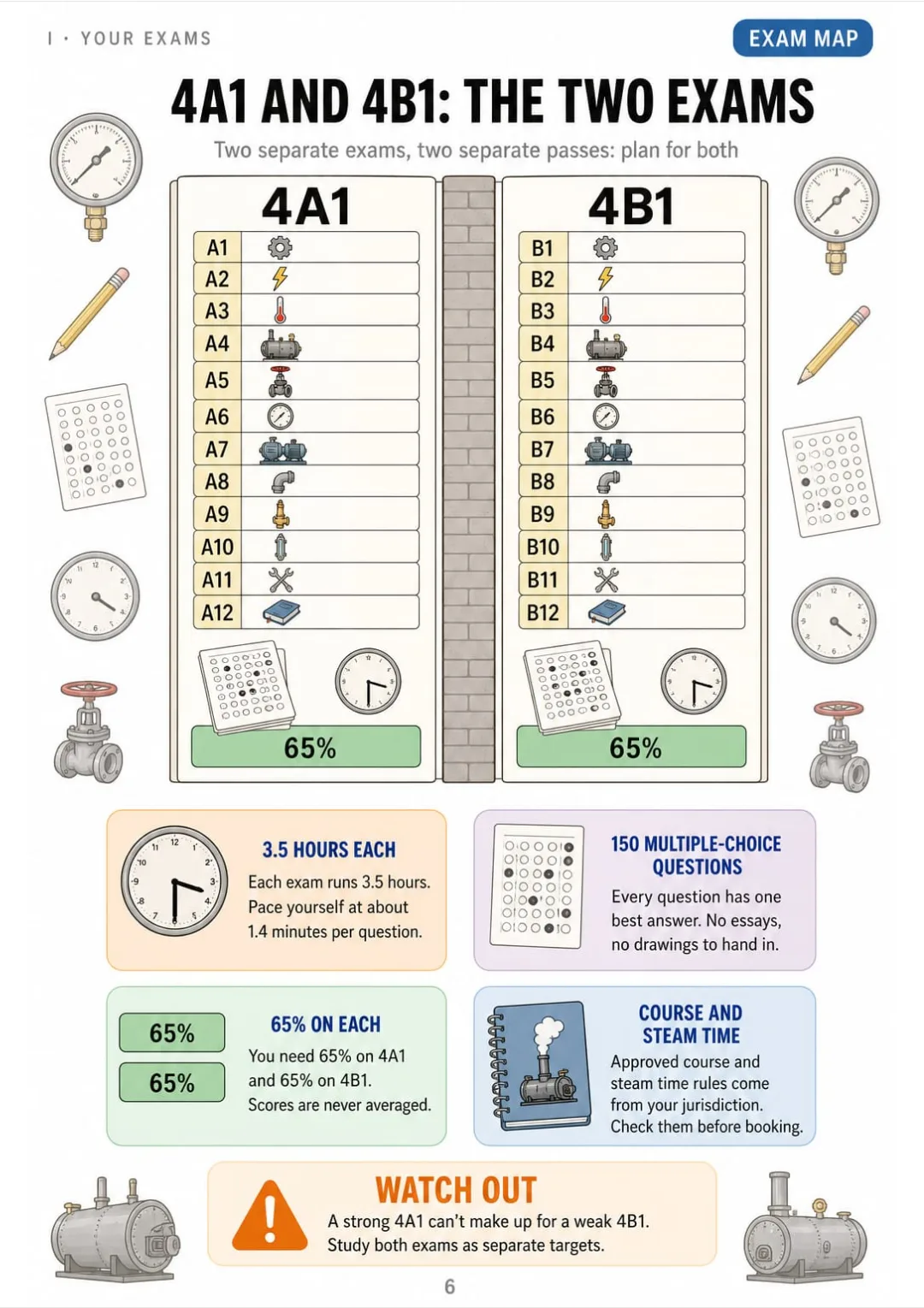
4A1 + 4B1: 3.5 hours, 150 questions and 65% needed on each exam
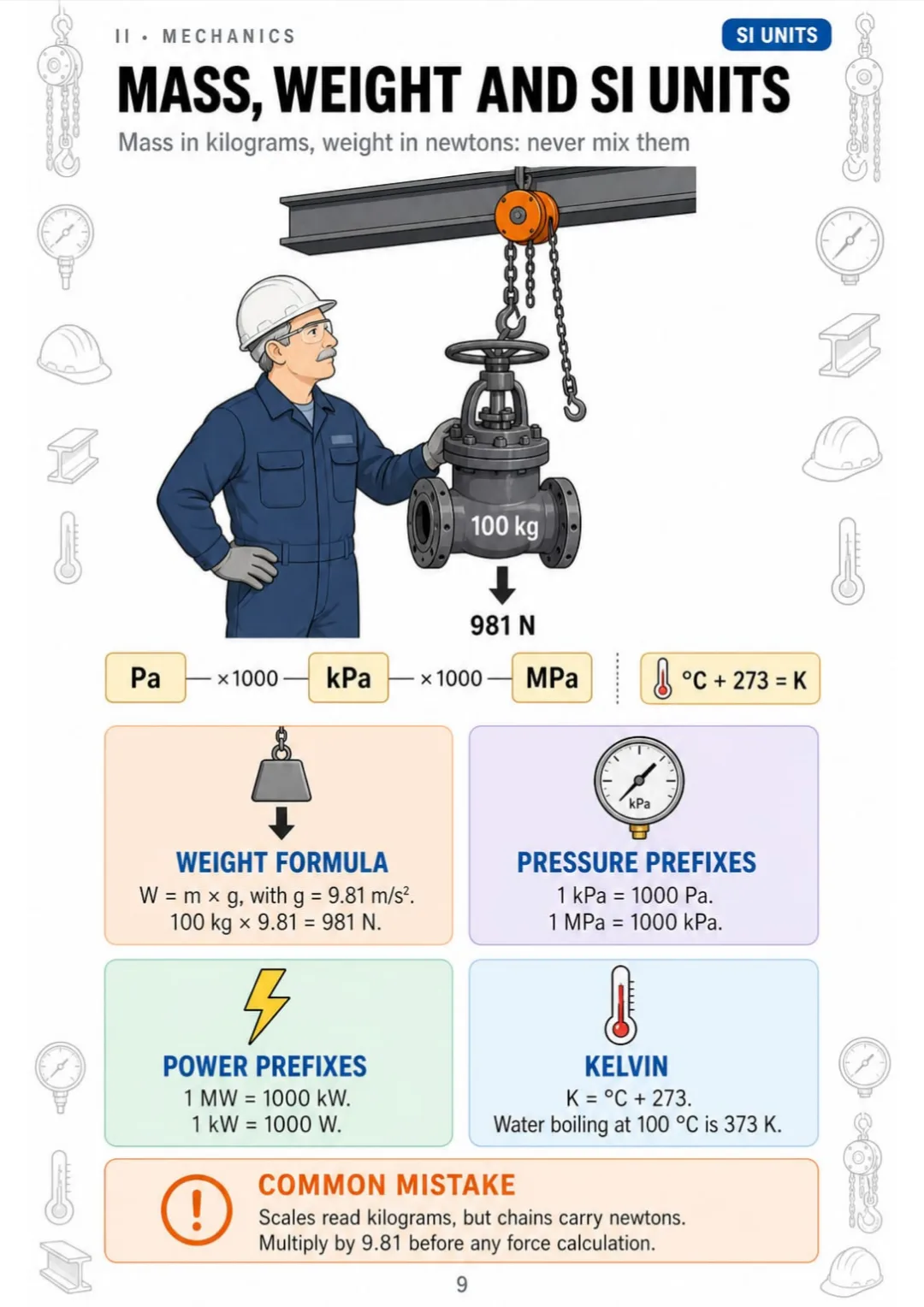
W = m × g: 100 kg × 9.81 m/s² = 981 N, plus every SI prefix on one strip
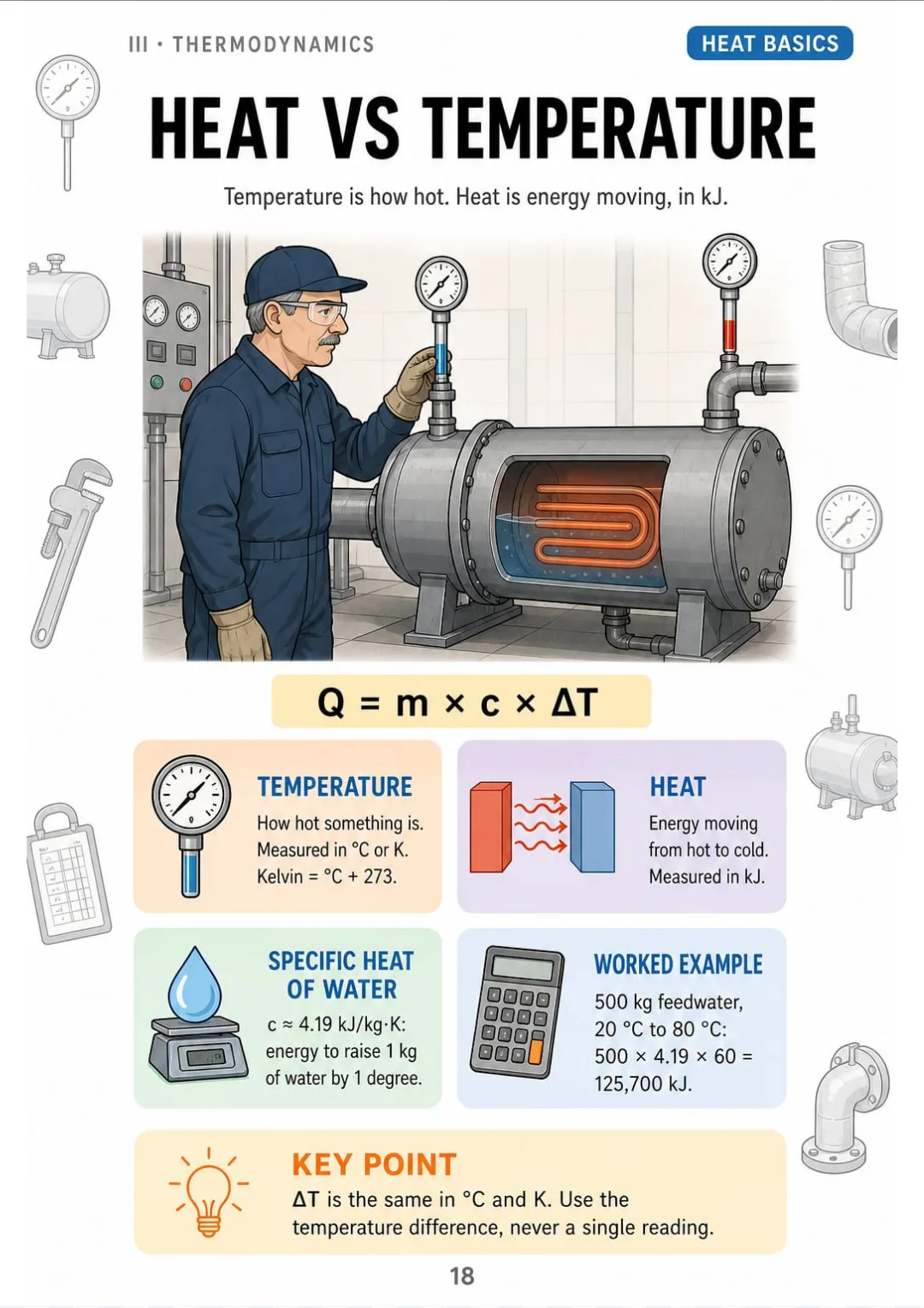
500 kg of feedwater from 20 °C to 80 °C = 125,700 kJ, worked step by step.
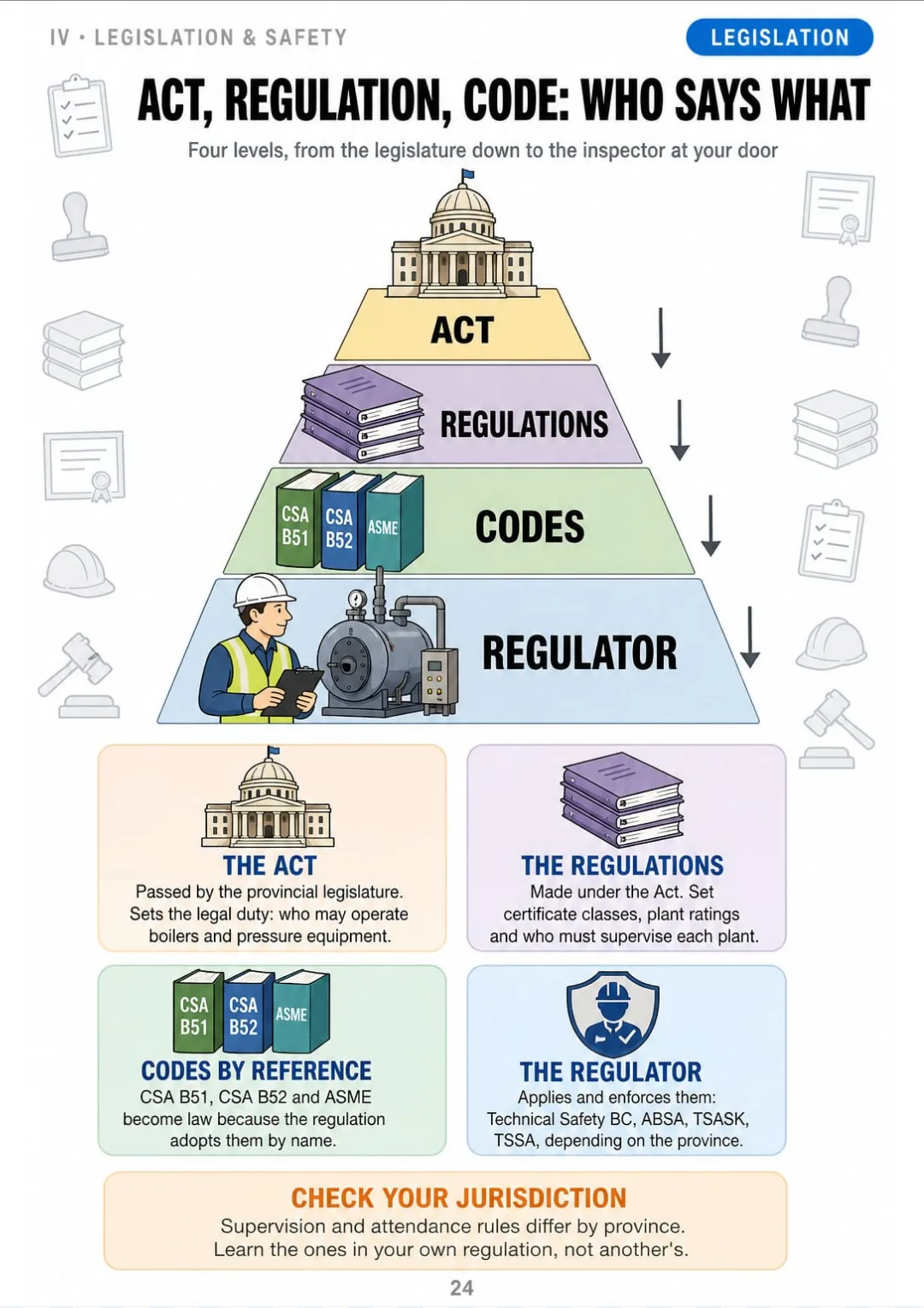
Act → Regulations → Codes by reference → Regulator: the four levels of boiler law in one pyramid.
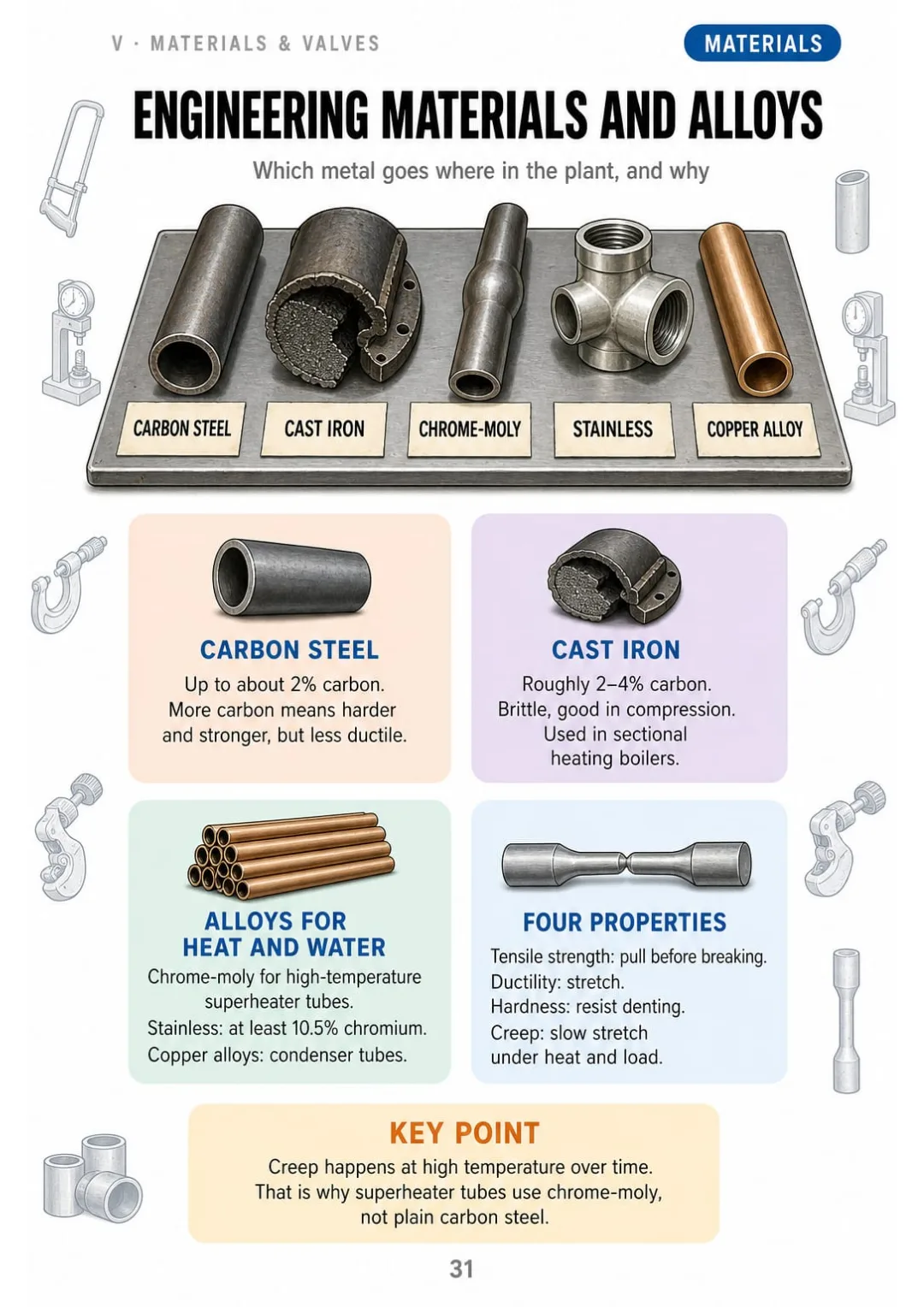
Carbon steel up to ~2% C, cast iron 2–4% C, stainless ≥10.5% Cr
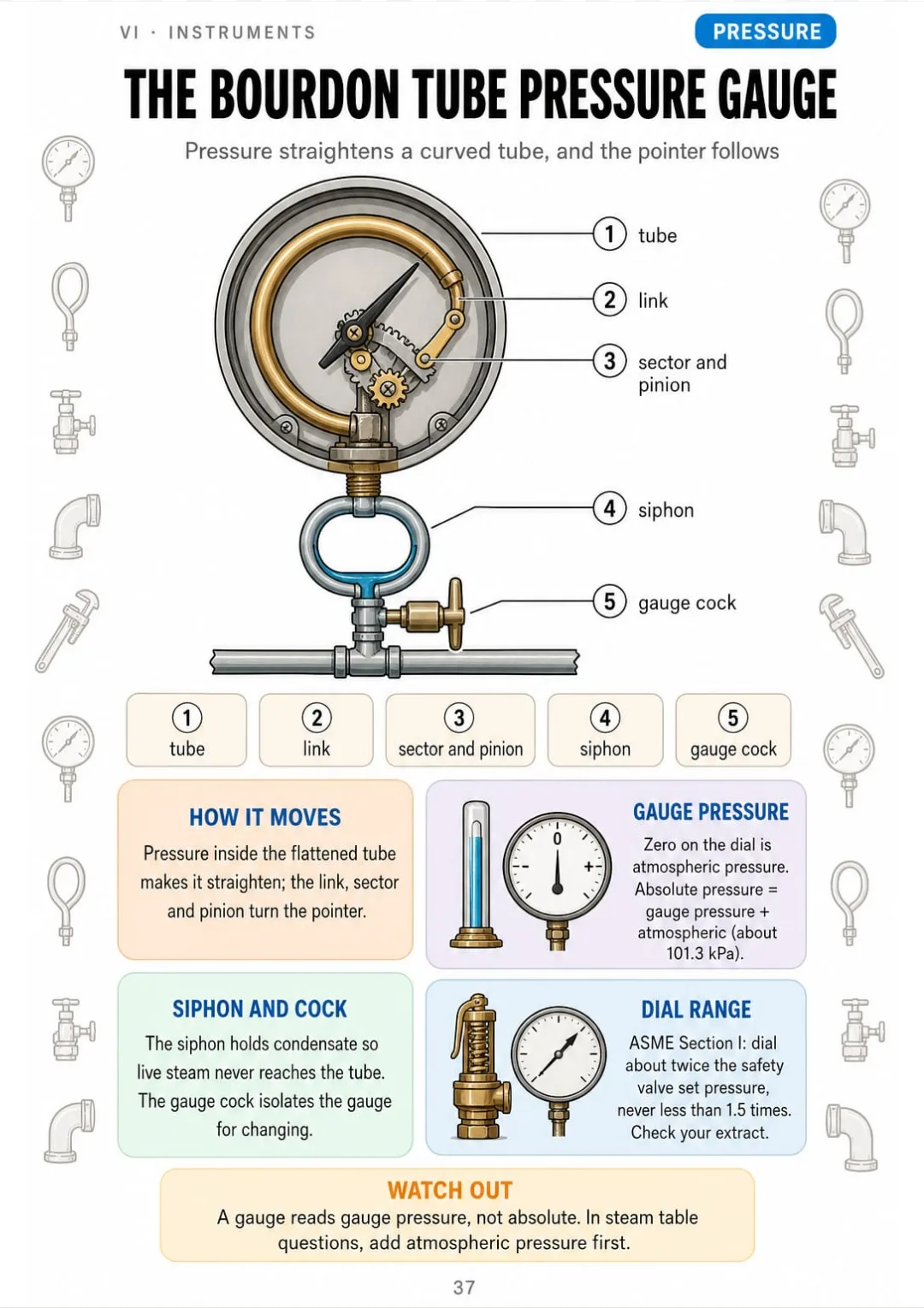
Bourdon tube, siphon and gauge cock in one cutaway, plus the ASME dial range rule.
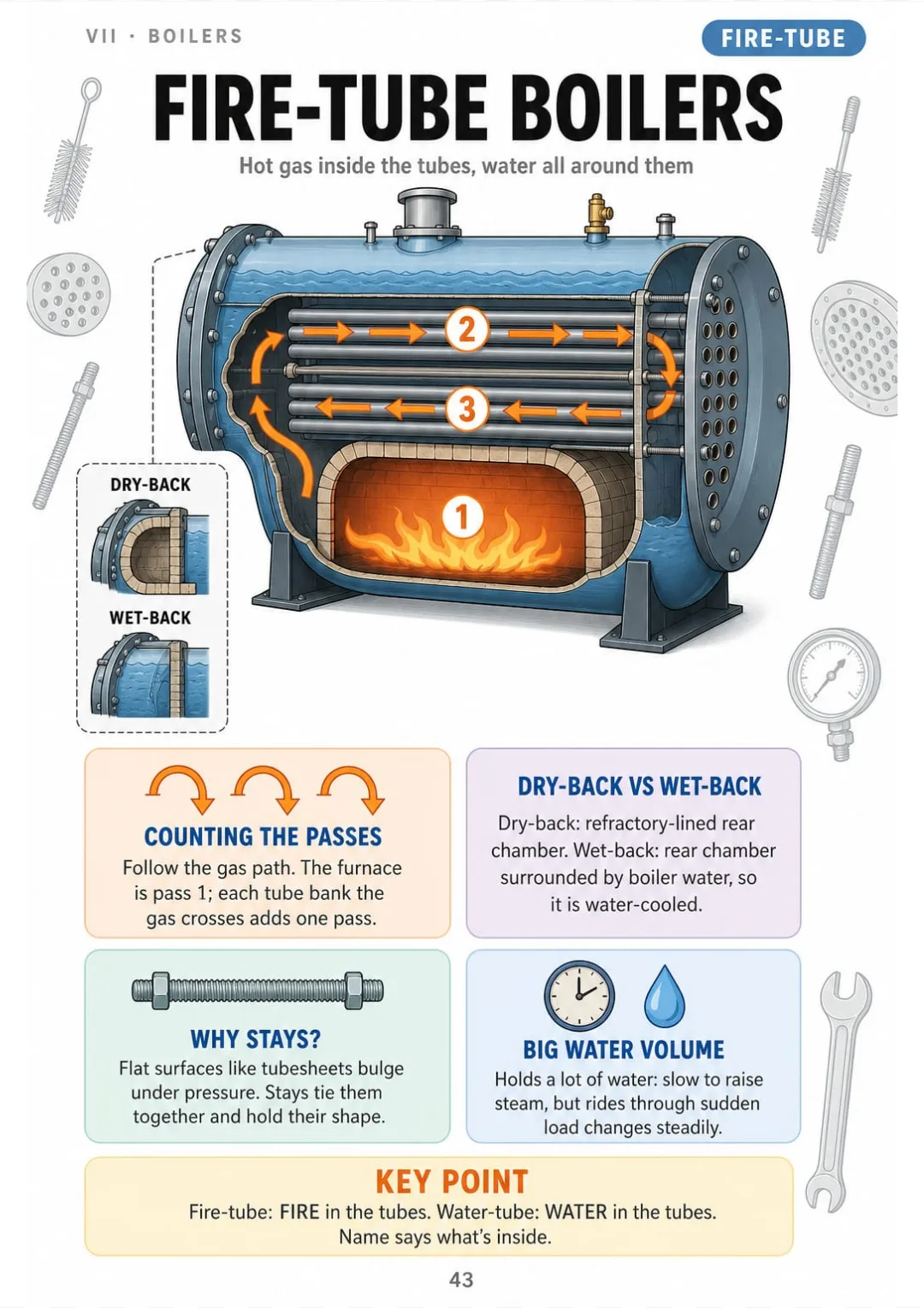
Scotch marine cutaway: furnace = pass 1, dry-back vs wet-back, stays on the tubesheets
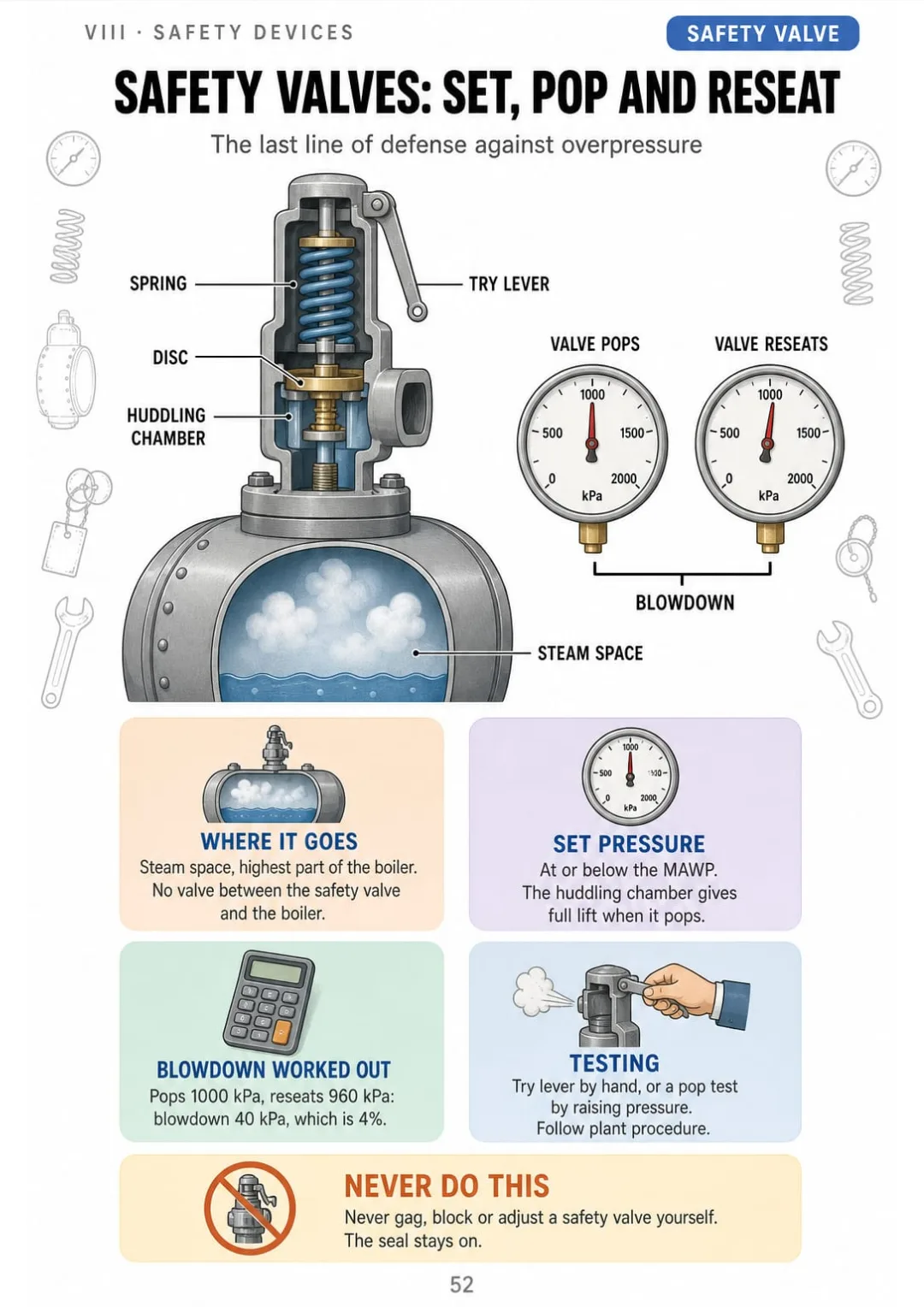
Safety valve cutaway: huddling chamber, try lever and a worked 4% blowdown

Swipe to see more →

These are real pages from the book. The table of contents is the full one: 11 parts and 79 topics.

Nobody Ever Put It in Order for You.

You've read the section on heat and temperature three times. You close the course book...

...and you can't remember which one is measured in kJ and which in °C, or where the specific heat goes in the formula. It was just lines of text, one after another.

500 kg of feedwater from 20 °C to 80 °C = 125,700 kJ, worked step by step.

Here heat vs temperature is one page: 500 kg of feedwater going from 20 °C to 80 °C, with Q = m × c × ΔT worked step by step all the way to 125,700 kJ.

And on the pages next to it, every topic has its own: sensible vs latent heat, saturated and superheated steam, heat transfer, heat exchangers and the gas laws.

First you understand why it works that way. Then the order of the steps stays with you on its own.

SEE THE DIFFERENCE

Stop memorizing formulas you can't picture:

THIS
  • Pages and pages of tight text
  • Formulas without a single drawing
  • On exam day, you don't know where to start
Mass is defined as the quantity of matter contained in a body and is expressed in the SI system in kilograms (kg), whereas weight is the force exerted on that mass by gravitational attraction and is expressed in newtons (N). The relationship between the two quantities is given by W = m × g, where g represents the acceleration due to gravity, taken as 9.81 m/s². It should be noted that multiples and submultiples of SI units are designated by standard prefixes, including kilo (10³), mega (10⁶) and milli (10⁻³).
FOR THIS
  • Every concept drawn
  • One topic per page, with the rules in boxes
  • You remember it because you've seen it
W = m × g: 100 kg × 9.81 m/s² = 981 N, plus every SI prefix on one strip
CONTENTS

Take a Look at the 11 Parts and 79 Topics

Your exams, mechanics and electricity, thermodynamics and steam, legislation and safety, materials and valves, instruments and controls, boilers, boiler safety and operation, pumps, water treatment and prime movers, building systems and HVAC, and the final review: 84 pages, all drawn

IYour 4th Class Exams · pp. 6-8
  1. 4A1 and 4B1: Two Exams, 150 Questions Each
  2. What You May Bring: Formulae, Steam Tables, Code Extracts
  3. Reading the Steam Tables in 3 Steps
IIMechanics and Electricity · pp. 9-17
  1. Mass, Weight and SI Units
  2. Forces, Moments and Equilibrium
  3. Simple Machines: MA, VR and Efficiency
  4. Work, Power and Energy
  5. Friction on a Horizontal Plane
  6. Stress, Strain and Factor of Safety
  7. Ohm's Law and Power in DC Circuits
  8. Motors, Generators and Transformers
  9. Electrical Distribution and Safe Isolation
IIIThermodynamics and Steam · pp. 18-23
  1. Heat, Temperature and Specific Heat
  2. Sensible Heat vs Latent Heat
  3. Saturated, Wet and Superheated Steam
  4. Heat Transfer: Conduction, Convection, Radiation
  5. Heat Exchangers: Parallel Flow vs Counterflow
  6. The Gas Laws in One Drawing
IVLegislation, Safety and Environment · pp. 24-30
  1. Acts, Regulations, Codes and Standards: Who Says What
  2. CSA B51 and the ASME Code Sections
  3. Lockout and Isolation Before Work
  4. Confined Space Entry
  5. WHMIS and Dangerous Materials
  6. Fire Classes and Extinguishers
  7. Plant Emissions: Gas, Noise, Liquid and Solid
VMaterials, Welding, Piping and Valves · pp. 31-36
  1. Engineering Materials and Alloys
  2. Welding Processes and Weld Inspection
  3. Pipe Connections, Supports and Expansion
  4. Steam Traps and Drains
  5. Gate, Globe, Check and Ball Valves
  6. Reading a Valve Cross-Section
VIInstruments, Controls and Plant Drawings · pp. 37-42
  1. The Bourdon Tube Pressure Gauge
  2. Measuring Level, Flow and Temperature
  3. Transmitters, Controllers and Actuators
  4. Control Loops: Open vs Closed
  5. Burner Programming Controls
  6. Line Tracing and Plant Diagrams
VIIBoilers and Boiler Systems · pp. 43-51
  1. Fire-Tube Boilers
  2. Water-Tube Boilers
  3. Electric Boilers
  4. Power Boilers vs Heating Boilers: ASME Section I vs IV
  5. Combustion: Fuel, Air and Ignition
  6. Fuel Systems: Gas and Oil Trains
  7. Natural, Forced and Induced Draft
  8. Feedwater Systems
  9. Blowdown: Surface vs Bottom
VIIIBoiler Safety Devices and Operation · pp. 52-61
  1. Safety Valves: Set Pressure, Blowdown and Testing
  2. Low-Water Fuel Cutoff
  3. Gauge Glass and Try Cocks
  4. Flame Safeguard and Purge
  5. Feedwater Control: Single-Element to Three-Element
  6. Starting Up a Boiler Safely
  7. Routine Checks and the Plant Log
  8. Shutdown and Layup: Wet vs Dry
  9. Preparing a Boiler for Inspection
  10. Hoisting and Working at Heights
IXLubrication, Pumps, Water Treatment and Prime Movers · pp. 62-71
  1. Lubrication and Bearings
  2. Centrifugal vs Positive Displacement Pumps
  3. Cavitation and NPSH
  4. Compressors: Types, Startup and Shutdown
  5. External Treatment: Softening the Raw Water
  6. Internal Treatment and Boiler Water Tests
  7. Condensate and Cooling Water Treatment
  8. Steam Turbines: Impulse vs Reaction
  9. Condensers and Cooling Towers
  10. Gas Turbines and Internal Combustion Engines
XBuilding Systems, Refrigeration and HVAC · pp. 72-81
  1. Building Water Supply and Drainage
  2. The Vapour-Compression Refrigeration Cycle
  3. Refrigerants and Refrigeration Safety Controls
  4. Absorption Refrigeration
  5. Comfort Air: Psychrometrics Basics
  6. Ventilation, Filters and Ducts
  7. HVAC Coils and System Types
  8. Steam Heating Systems
  9. Hot Water Heating Systems
  10. Heat Recovery and HVAC Control
XIFinal Review and Exam Day · pp. 82-84
  1. Frequent Mix-Ups, Side by Side
  2. Exam Day Checklist
  3. After the 4th Class: What Comes Next

What If Every Topic Fit on a Single Page?

Imagine this:

Instead of rereading half a page on fire-tube boilers without being able to picture one...

...you open the page and find a Scotch marine boiler in cutaway, with the furnace as the first pass, dry-back next to wet-back and the stays on the tubesheets.

Carbon steel up to ~2% C, cast iron 2–4% C, stainless ≥10.5% Cr

And safety valves, the Bourdon tube gauge, feedwater, pumps and the refrigeration cycle turn into drawings and tables you read at a glance.

You stop repeating and start understanding.

That's exactly what The Power Engineer 4th Class Sketchbook does. It's not “just another textbook.” It's 11 parts and 79 drawn topics, and at the end the frequent mix-ups side by side and an exam day checklist.

Because what your brain sees organized, it remembers.

Here Is What You Get with The Power Engineer 4th Class Sketchbook:

Ipp. 6-8

Your 4th Class Exams

Know exactly what the 4A1 and 4B1 look like, what you may bring into the exam room, and read the steam tables in 3 steps.

IIpp. 9-17

Mechanics and Electricity

SI units, forces and moments, simple machines, work and power, friction, stress and factor of safety, Ohm's law, motors and safe isolation.

IIIpp. 18-23

Thermodynamics and Steam

Work any heat problem in the same steps: specific heat, sensible vs latent heat, saturated and superheated steam, heat transfer, heat exchangers and the gas laws.

IVpp. 24-30

Legislation, Safety and Environment

Acts, regulations and codes, CSA B51 and the ASME sections, lockout, confined spaces, WHMIS, fire classes and plant emissions.

Vpp. 31-36

Materials, Welding, Piping and Valves

Materials and alloys, welding and weld inspection, pipe supports and expansion, steam traps and the main valve types in cross-section.

VIpp. 37-42

Instruments, Controls and Plant Drawings

The Bourdon tube gauge, level, flow and temperature, transmitters and controllers, control loops, burner controls and line tracing.

VIIpp. 43-51

Boilers and Boiler Systems

Fire-tube, water-tube and electric boilers, Section I vs IV, combustion, gas and oil trains, draft, feedwater and blowdown.

VIIIpp. 52-61

Boiler Safety Devices and Operation

Safety valves, low-water fuel cutoff, gauge glass, flame safeguard, feedwater control, startup, routine checks, shutdown, inspection and working at heights.

IXpp. 62-71

Lubrication, Pumps, Water Treatment and Prime Movers

Lubrication, pumps, cavitation, compressors, water treatment, steam turbines, condensers, cooling towers, gas turbines and engines.

Xpp. 72-81

Building Systems, Refrigeration and HVAC

Building water and drainage, refrigeration cycles and controls, psychrometrics, ventilation, HVAC coils, steam and hot water heating, and heat recovery.

XIpp. 82-84

Final Review and Exam Day

The frequent mix-ups side by side, the exam day checklist and what comes after the 4th Class.

At the end of the book: The frequent mix-ups side by side and an exam day checklist.
And That Is Not All: 2 More Books, Free

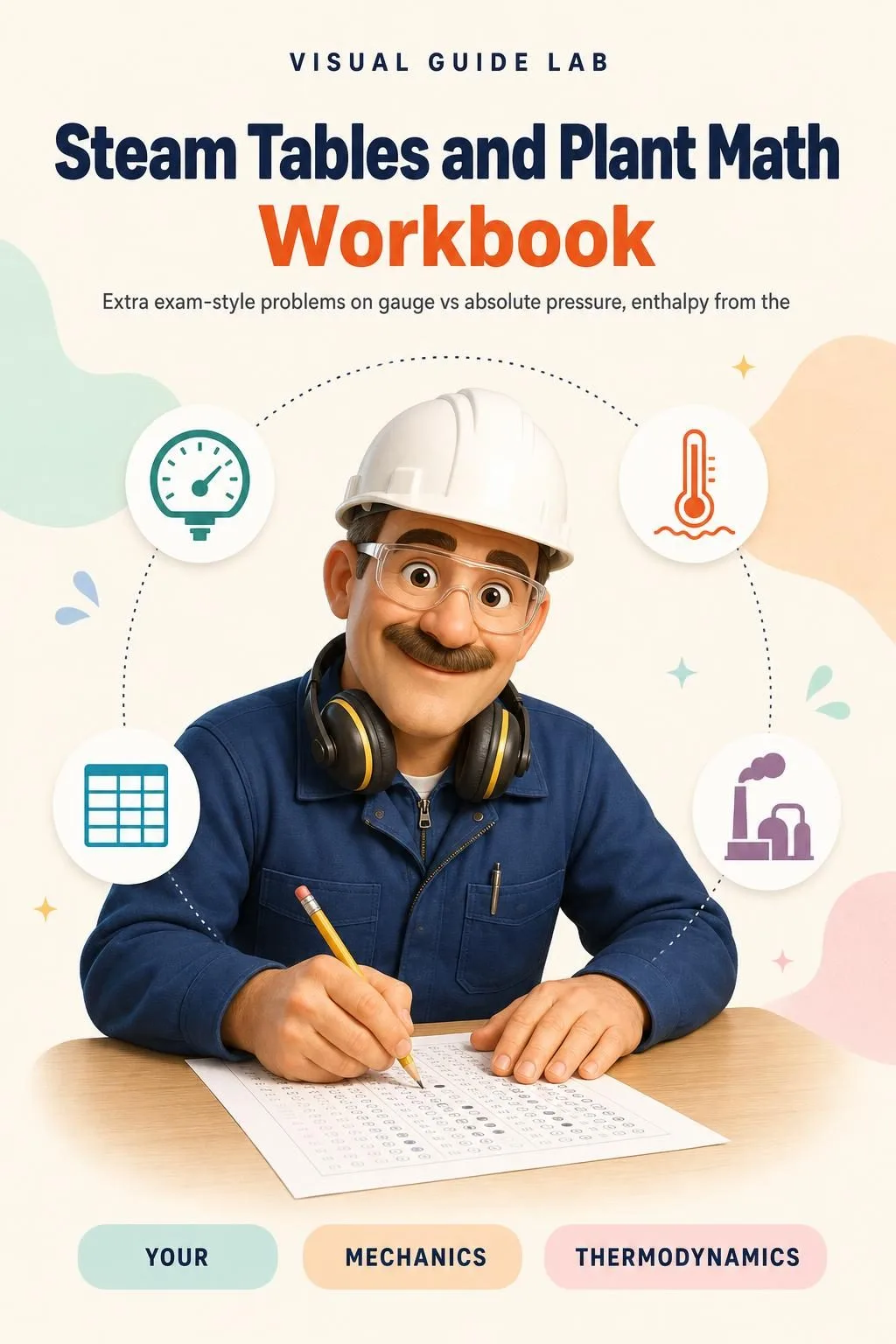
Steam Tables and Plant Math Workbook

BONUS 1: «Steam Tables and Plant Math Workbook»

Value on its own: CA$ 24.99

Extra exam-style problems on gauge vs absolute pressure, enthalpy from the steam tables, heat transfer, boiler efficiency, pump power and Ohm's law, each one worked in the same steps as the book, so the math stops feeling like guesswork.

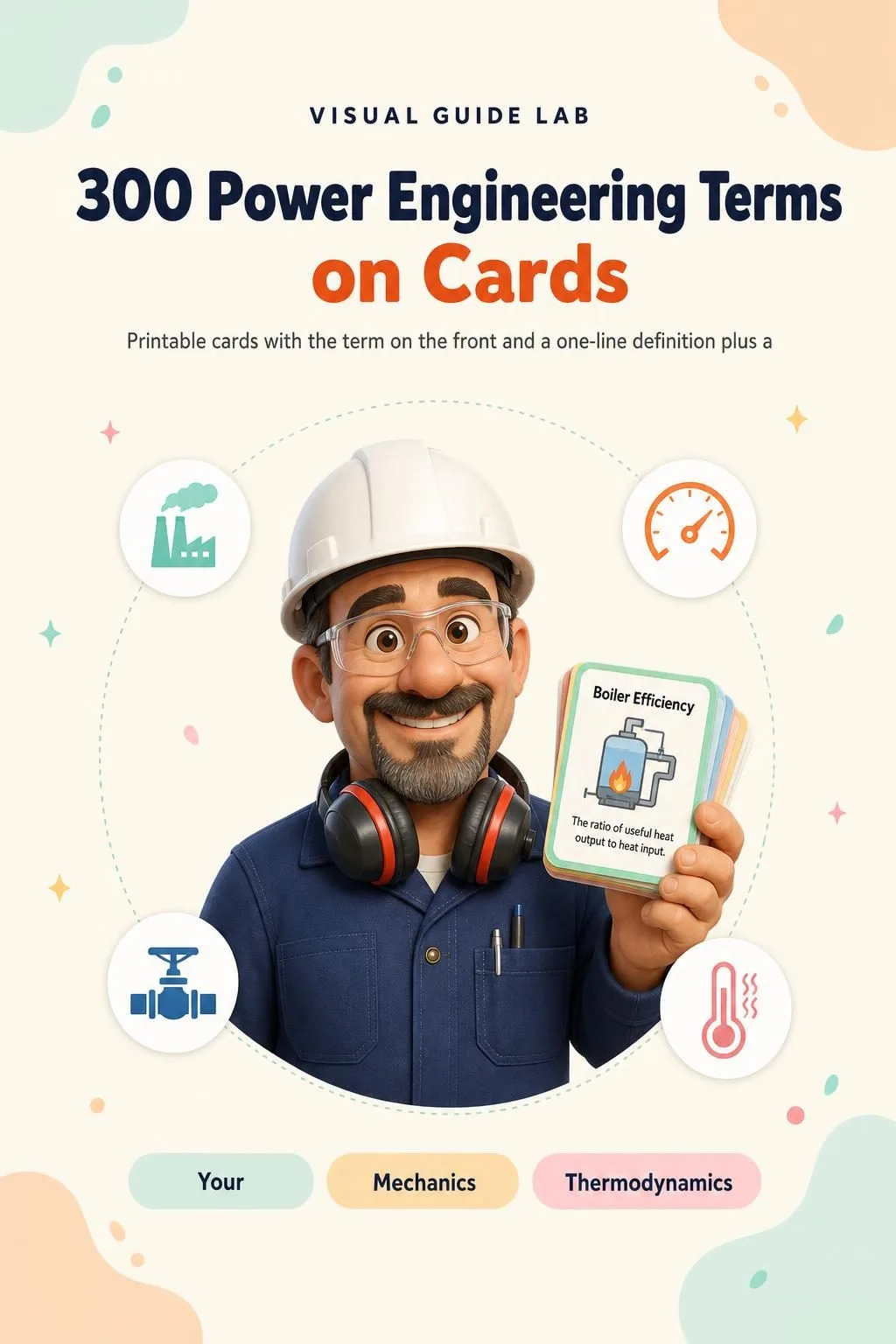
300 Power Engineering Terms on Cards

BONUS 2: «300 Power Engineering Terms on Cards»

Value on its own: CA$ 19.99

Printable cards with the term on the front and a one-line definition plus a tiny sketch on the back, to review the vocabulary in short breaks between shifts.

The Power Engineer 4th Class Sketchbook + 2 Free Books

  • The Power Engineer 4th Class Sketchbook: 84 drawn pagesCA$ 79.99
  • BONUS 1: Steam Tables and Plant Math WorkbookCA$ 24.99
  • BONUS 2: 300 Power Engineering Terms on CardsCA$ 19.99
  • High-resolution PDF to printIncluded
Total value CA$ 124.97
YOUR PRICE:
CA$ 34.99
You save CA$ 89.98
YES, I WANT THE POWER ENGINEER 4TH CLASS SKETCHBOOK FOR CA$ 34.99

📄 This is a digital PDF book sent to your email: nothing is printed or shipped.

Secure purchaseEncrypted payment30-day guarantee

PDF by email: The Power Engineer 4th Class Sketchbook reaches your inbox as a PDF, and the two free books come by email too. One-time payment, no installments or hidden costs.

Is This Book for You?

You're taking the 4th Class course

You're taking the 4th Class course

Every 4A1 and 4B1 topic on one drawn page, in syllabus order, to go over between classes and shifts.

Your 4A1 or 4B1 is coming up

Your 4A1 or 4B1 is coming up

The full review in the order of the syllabus, the plant math always in the same 5 steps, and the frequent mix-ups side by side at the end.

You already work in a boiler room

You already work in a boiler room

The plant you walk every shift, drawn: gauges, safety valves, feedwater and blowdown, so you can explain on paper what you already do.

To Sum Up: Here Is What You Get

CA$ 124.97CA$ 34.99
YES, I WANT THE POWER ENGINEER 4TH CLASS SKETCHBOOK FOR CA$ 34.99

📄 This is a digital PDF book sent to your email: nothing is printed or shipped.

30DAYS
GUARANTEE

30-Day Guarantee

30-day guarantee: tell us what didn't work and we'll refund 100%.

You have 30 days to try The Power Engineer 4th Class Sketchbook and the two bonus books. If it doesn't help you study, tell us what didn't work and we'll refund 100% of what you paid. One-time payment, no subscriptions, no surprises.

Frequently Asked Questions

How do I get the material?

You get an email, at the address you enter at checkout, with The Power Engineer 4th Class Sketchbook as a high-resolution PDF, to read on your phone, tablet or computer, or to print. The same email brings the two bonus books: Steam Tables and Plant Math Workbook and 300 Power Engineering Terms on Cards. If you don't see it, check your spam folder or email us.

Is it a monthly or a one-time payment?

One-time payment in Canadian dollars (CAD). No installments and no subscription.

Who is it for?

For anyone preparing for the 4A1 and 4B1 exams under the Canadian SOPEEC Fourth Class syllabus: people taking the approved course, people retaking an exam and operators who already work in a plant. Quebec has its own system and isn't covered. It isn't based on any US state or city boiler operator or stationary engineer license exam. It isn't only for beginners: it starts from the syllabus basics and goes topic by topic, so it also works as a review. Check the index above to see every topic.

What sources is it based on?

On the SOPEEC Fourth Class Power Engineer syllabus (2017 edition) as published by Technical Safety BC, checked against the public scope of CSA B51 and CSA B52, the general principles of ASME Sections I and IV, WHMIS 2015 and standard steam property values.

Is it official material?

No. It's an independent study book that follows the SOPEEC 2017 syllabus. It isn't published or endorsed by SOPEEC, Technical Safety BC, ABSA, TSASK, TSSA or any other regulator. It doesn't give you a certificate, a course credit or steam time: your certificate only comes from passing your jurisdiction's exams.

Does it replace my 4th Class course?

No. It doesn't replace your approved course, your course textbooks, your qualifying steam time or your plant's procedures. What it adds: the same syllabus, one topic per page, with the equipment drawn in cutaway and the plant math worked in the same 5 steps, so you can review in short sessions between shifts. For steam time and exam rules, check your jurisdiction's regulator.

Are the practice questions the ones on the exam?

No. The problems in the Steam Tables and Plant Math Workbook are written for this book. They aren't official exam questions: they're there for practice.

Can I print it?

Yes. The PDFs are high resolution, for reading on your phone or printing, and the 300 term cards are laid out to print and cut.

What if I don't like it?

You have 30 days: tell us what didn't work and we'll refund 100%.

One Last Thing Before You Decide...

You don't have to reread the same page hoping it sticks this time.

You don't have to memorize formulas you can't picture.

And you definitely don't have to walk into the exam not knowing where to start.

One last thing before you decide: 84 drawn pages in syllabus order, 2 bonus books, PDF by email, and 30 days to tell us if it didn't work for you.

One-time payment: CA$ 34.99 · Guarantee: 30 days · PDF by email

YES, I WANT THE POWER ENGINEER 4TH CLASS SKETCHBOOK FOR CA$ 34.99

📄 This is a digital PDF book sent to your email: nothing is printed or shipped.